Explore Your Archive’s theme this July is Architecture. This summer also sees the FIFA World Cup taking place in Canada, Mexico and the United States. What better time than now for the Historic England Archive to celebrate its Football Grounds of England Collection?
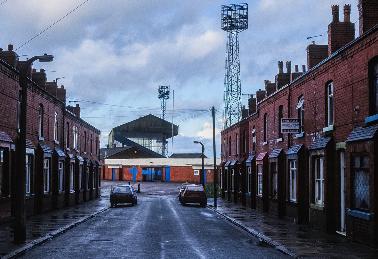
The evolution of football grounds
Our Football Grounds of England Collection comprises 2,248 digitised photographs taken by the writer, architectural historian and Aston Villa fan, Simon Inglis. Some of them can be seen in Inglis’ seminal book ‘Football Grounds of Britain’, which was first published (as ‘Football Grounds of England and Wales’) in 1983.
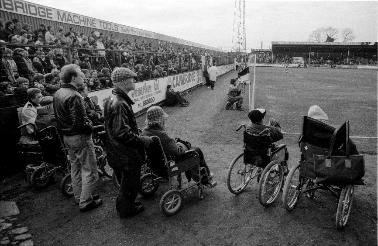
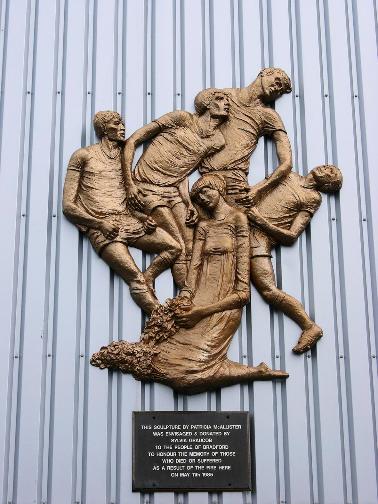
The photographs in the collection were taken between 1980 and 2019, with the majority taken in the 1980s and 1990s. During this period, two major tragedies led to great changes at football grounds, the 1985 Bradford City fire and the 1989 Hillsborough disaster. Inglis’ photographs are an important record of how football grounds looked before these events. They show the changes made as clubs responded to legislation passed to improve safety at football grounds.
Discover the collection
By the time the World Cup Final kicks off, our Football Grounds of England Collection will be fully catalogued and available to view online, using our Explore Archive Collections function on the Historic England website.
To help celebrate the collection, we’ve also arranged for an exhibition to take place at Swindon Central Library. With support from our friends at the library’s Local Studies team, a selection of Inglis’ photographs has been printed and will be on show at the library’s Courtyard Gallery between 29 June and 24 July.
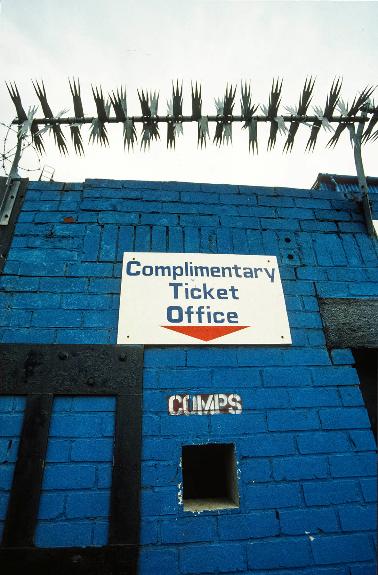
All the photographs in the exhibition have been chosen by football fans. As well as standard exhibition captions, we decided it would be great to accompany some of the photographs with personal stories, recollections and comments that connect fans to the grounds, stands, terraces and memorable events that happened at them.
Football fans and their stories
Football fandom is an incredibly social activity. As football fans we meet up with relatives and friends, walk familiar streets, or travel hundreds of miles together in cars, coaches and trains. Even when we go to a game on our own, we’re soon part of a host of thousands gathered at the same place at the same time to experience the same event.
Yet, our experiences of that same event are often remarkably different. Our first matchday experience, our later pre-match rituals, where we stand or sit, and the significance of the game determine our experiences, good or bad, and consequently, our memories.
The fan captions offer a variety of experiences. From memories of a specific match to broader feelings about the existential nature of being a football fan, they give the visitor to the exhibition an engaging insight into the world of the football fan. Especially one who knows what it is like to attend football matches at the kinds of grounds featured in the photographs on display.
The fans who contributed to the exhibition were born between 1937 and 1980, with their memories dating back to events from the 1960s to more recent times. Regardless of the teams they support, the photographs they selected, or the events they recollect, each caption resonates with fellow football fans. For those visitors who aren’t football fans, the captions provide a brief insight into what football fandom can mean.
Whether or not visitors to the exhibition are football fans, have an interest in football grounds, architecture, photography, urban history or social history, we hope that the personal stories that sit alongside Inglis’ photographs take the viewer beyond the architecture and its location, and inspire them to ponder what their football ground story would be.
Handing over to the fans themselves
Here are some examples of the fan captions, alongside the photographs they selected for the exhibition.
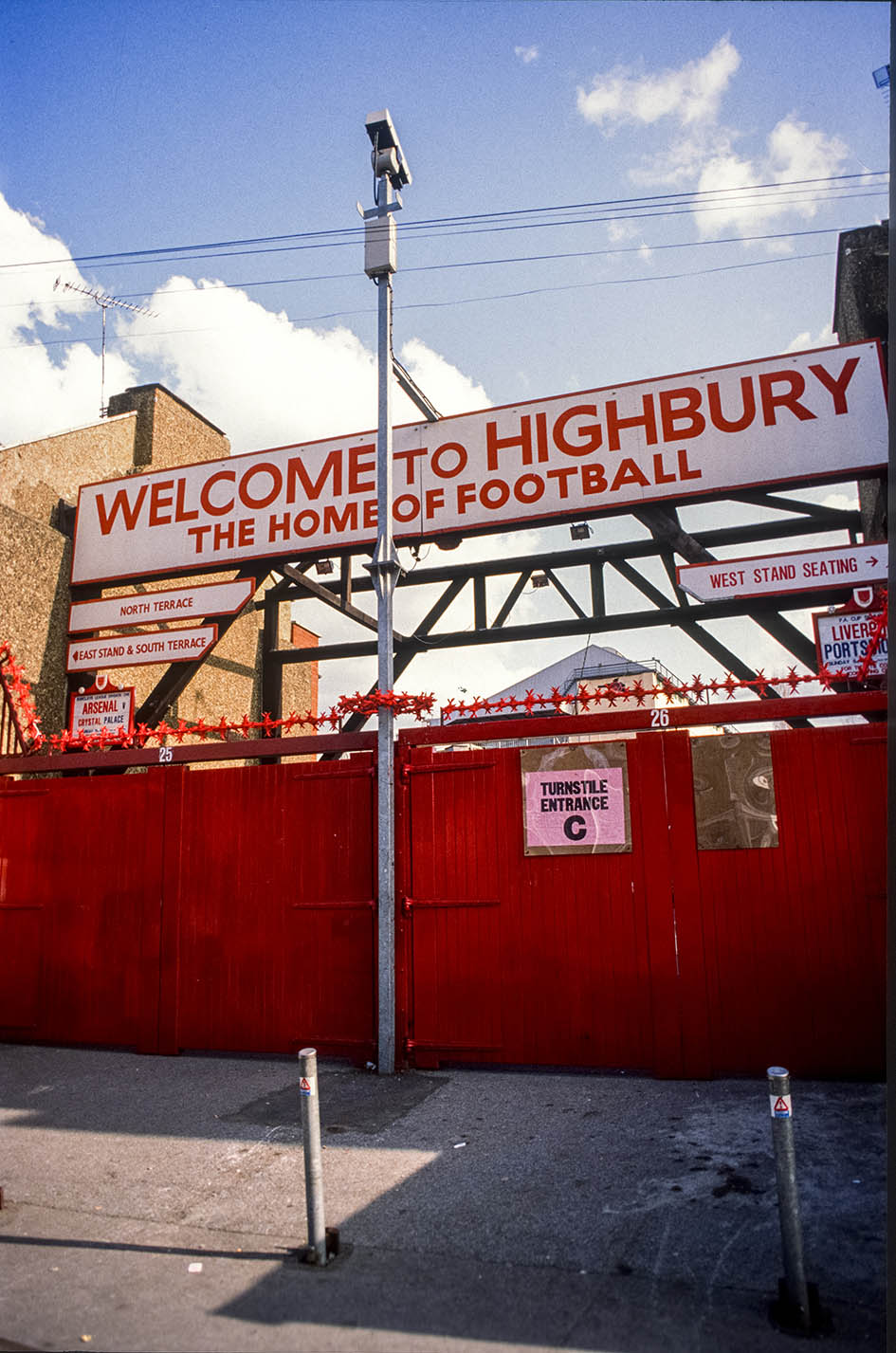
Highbury
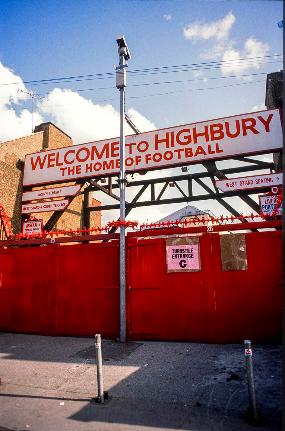
In them days – the 1960s – they didn’t bother with all ticket games much, so a group of us set out to watch Arsenal versus Man United at Highbury. We went by train from Swindon station to Paddington, then took the Underground to Highbury. We ran round the ground to try to find a gate that was still open. We were so disappointed because they’d locked all the gates before we could get in.
Some Arsenal supporters were also trying to get in like us. One of them pointed at me and said to his mates: “Look boys, it’s Bobby Charlton!” One of my mates then joked I should go round the players entrance to get in the ground! I was about the same age as Charlton at this time and did look a bit like him. Although I played a lot of football, I don’t think I was quite as good as him. But this made my day. I think Charlton scored in a win for Man United.
We hung about outside listening to the roars of the crowd. We thought about going into a pub to drown our sorrows. Of course, in those days the pubs didn’t have games on TV, so we ended up in the British Museum for a couple of hours, before catching the train back to Swindon.
I think this photograph sums up my experience of going to Highbury.
Cecil
Born: 1937
Supports: Swindon Town
Elm Park
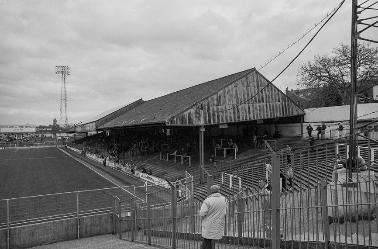
When I was about 17 or 18, my boyfriend picked me up from Wills cigarette factory and we drove in his Morris Oxford to go to Reading to watch Swindon play at Elm Park. I was trying to impress my boyfriend by going to football, as us girls used to. I was dressed in a skirt and stiletto heel winklepicker shoes, had a bouffant hairstyle, and I felt the ‘bee’s knees’ in his car.
At the match we were stood in the open and it started to absolutely chuck down with rain, so we all moved under the stand. During the game, my boyfriend shouted out, telling the players what to do, and the people in front turned round and said: “Will you shut up and watch the game!”. Of course, I got scared and I moved along a bit to make it look as though I wasn’t with him. When Swindon scored, the whole crowd pushed forward and I nearly fell over, sopping wet.
It was about 20 years before I went to a football match again. We’ve been married 60 years and now I watch three generations heading off to football every other Saturday, giving me two hours of peace and quiet.
Pam
Born: 1944
Supports: Arsenal
County Ground
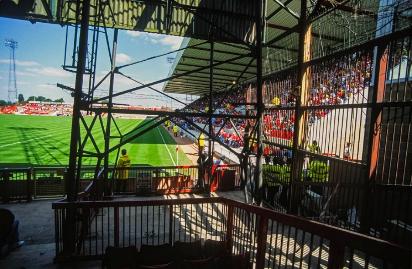
Football represents an escape; from mundanity, from normality, from a life that might not be the one you chose. Football represents a life where the collective spirit and a sense of belonging can move mountains, where everyone is accepted as long as they wear the right colours and where the glory and the success can be shared, enjoyed and savoured. A world where everything is possible, where colours are brighter, sound is louder and bonds are firmer.
Yet football also represents a cage, something that has limitations, boundaries and the sense of belonging means that there cannot be an escape. Rarely do you choose your football club, instead it chooses you. Handed down through generations, a lottery of where you live or a choice made on the spur of the moment. Once selected, there is no going back. You are who you are.
Where you watch fits into the pattern of belonging and this photograph encapsulates the sense of being a football fan. Behind the goal, away from the action, floodlights impeding your view and a better view in a modern stand enticing you but, this is your spot. This is where you watch from and this is where you belong. The colours, the excitement, the highs, the lows and the sense of being somewhere you belong, however imperfect it might be.
Football life encapsulated in one photograph.
Peter
Born: 1971
Supports: Swindon Town
Villa Park
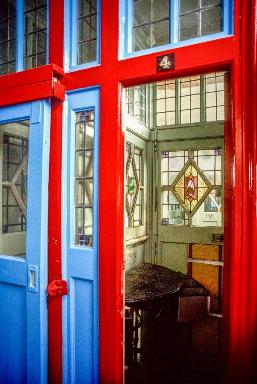
Football supporters of my vintage will effortlessly recall the magical clunk of an Ellison’s Rush Preventive turnstile that, for millions of fans in the 20th century, heralded our passage from the outside world of everyday reality to the magical interior and shining turf of an English football ground.
I first passed through one such stained glass turnstile serving the Trinity Road Stand at Villa Park in April 1962, at the age of seven. The Jesuits used today, ‘Give me the boy at seven and we will give you the man.’ In my case, I went on not only to support Aston Villa but also to develop a fascination for architecture, and in particular stadium architecture, which in turn led me to take all these photographs – now in the safe hands of Historic England – and to write the biography of the man who designed the Trinity Road Stand, Archibald Leitch.
I like to tell myself that it was the design of the stand, its Edwardian red brick façade, ornate mosaic detailing and all the smells and noises that filled its cavernous interior that inspired me, even as a seven-year-old. But it may also have helped that Villa won handsomely that afternoon, beating Leicester City by the extraordinary margin of 8-3.
Either way, by passing through that turnstile my life changed, leading to so many afternoons and evenings spent in that cavernous stand, feeling its majesty and historical heft, cheering on the lads.
Simon
Born: 1955
Supports: Aston Villa
Further information
Written by Gary Winter, Archive Engagement & Content Officer at Historic England Archive
Edited by Alex Cattermole, Blog Coordinator for Explore Your Archives
Find out more here: https://historicengland.org.uk/images-books/archive/collections/