For today’s #EYAInclusion we’re handing over to the King’s Fund Library’s team to highlight their recent work around accessibility and services for disabled people.

Some years ago, The King’s Fund Library team decided to bring our Digital Archive to life through a series of blogs and exhibitions. For each exhibition we did, we went through a learning process and used this to try and improve on the next exhibition.
The first exhibitions
The first online exhibition we did looked at the history of nursing where we experimented with different platforms and published this on International Nurses Day in March 2020. We used a different platform for our second exhibition on hospital food and worked more closely with our Digital and Design teams. It was The King’s Fund’s 125th anniversary in 2022, so for our third exhibition we created a timeline on key points from the history of the organisation. There were two significant anniversaries in 2023 – it was 75 years since the creation of the NHS as well as the arrival of NHS Windrush. This led us to an exhibition celebrating the contribution of the Windrush generation to the NHS.
A new approach
In October 2023 we were approached by a colleague to produce an exhibition for Disability History Month. We realised that the process would take far longer than the few weeks we had to get something ready for Disability History Month 2023. We agreed to take our time and aim to publish in Disability History Month in 2024.
Unlike our previous exhibitions, we didn’t have a specific story in mind to tell in the early stages. Therefore, we decided to start with a look at the resources we had in the archive on disability and long term conditions. While we had done a lot of work historically on mental health, we decided we wouldn’t cover this subject in this exhibition. There would have been too much material to allow us to have a useful focus.
What items to choose
We started off with a long list of reports – a lot more than we were expecting! A group of three of us got together to start trying to identify themes within the reports we’d published. However, it wasn’t immediately obvious what these themes would be. We hit upon the idea of showcasing miscellaneous surprising items that we’d found in place of a story. As we were arranging these a story did evolve around the theme of ‘An ordinary life’. This was a body of work that The King’s Fund did which aimed to improve conditions for disabled people in all aspects of their lives. It covered work, clothing, the home environment and education as well as the caring environment.

Accessible interpretation
From the outset we wanted to make sure this exhibition was as accessible as possible given the time and budget restraints that we had. This involved researching how an exhibition might work with screen readers and how text and colour should be used.
As an aside, given the historical nature of the material drawn on for the exhibition, we were careful to acknowledge that the language in some of the older reports wouldn’t be acceptable now.
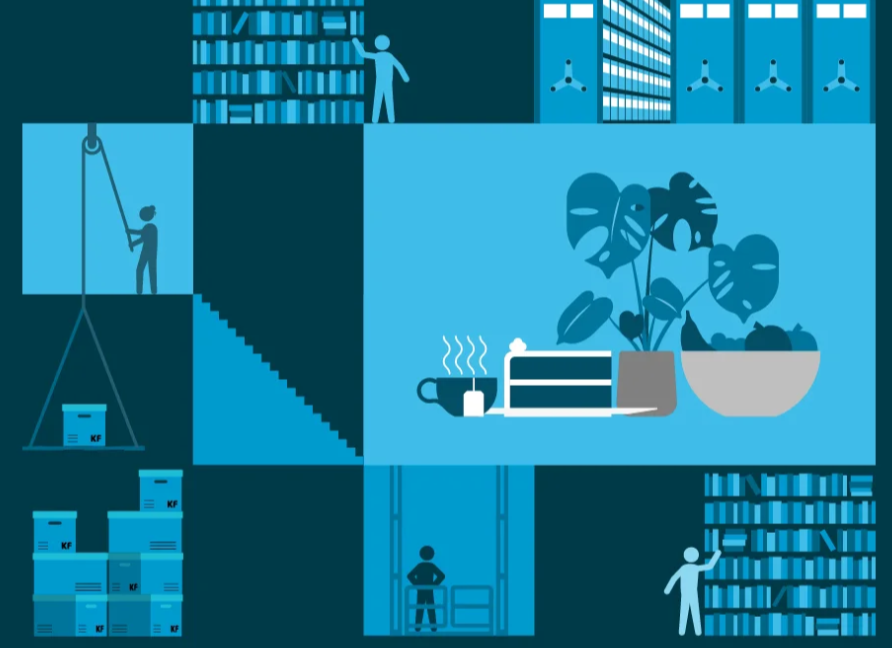
We are very lucky to work with some talented graphic designers who got straight to work on creating images and videos to make it a bit more visually striking. Given our wish to make the exhibition more accessible than any of our previous efforts, this involved a lot of “back to the drawing board” as we realised moving images could be problematic. We did include some static images to break up the text but made sure each one included alt-text so screen readers could see the description of the image.

Working for screen readers
We did some research into screen readers and how they could help people read and view online exhibitions. To help with this, we created plain text versions of the archive documents we linked to throughout the exhibition. This involved creating an unformatted text document from the existing archive document and then working through each one to tidy up the formatting, remove scrambled text and re-creating tables where possible. It was helpful to have the hard copy document alongside this. We did experiment with AI tools to try and assist with this but found we needed to review the documents very carefully to make sure the text still made sense and flowed properly. You can see an example here.
Additionally, we created a text only version of the exhibition for those who found it easier to avoid images altogether as well as a large print, text only version.

Looking back and looking ahead
One idea that sprang from creating these plain text versions of documents for this exhibition was to go back through the previous exhibitions we’d created and retrospectively make these more accessible by adding in plain text versions of the linked documents. In the future, we’d also like to be able to produce a plain text version for any report held within our archive on request.
We were lucky enough to be able to work closely with our Digital team colleagues to get advice on making the exhibition accessible, within the limited budget we had. However, there’s also some really useful advice online. For example, Abilitynet have published a guide to digital accessibility. Eye-Able have created a guide to the Web Content Accessibility Guidelines and outline the benefits of complying with these. We were also grateful to have the guidance of our Disability and Long Term Conditions Staff Network who helped shape the content throughout the whole process.
Although we haven’t got another exhibition in the pipeline at the moment, we would definitely include these accessibility features as standard in the future.
Please have a look at the exhibition and let us know what you think!
Further information
Written by Nikki Smiton, Librarian at King’s Fund.
Edited by Isabel Lauterjung, Blog Coordinator with Explore Your Archive.
Find out more about the King’s Fund Library and their Digital Archive here: https://www.kingsfund.org.uk/work-with-us/knowledge-research-services
** Update from the King’s Fund regarding their collections online:
From 1 February 2026 The King’s Fund digital archive will be temporarily unavailable. The archive provides access to The King’s Fund’s wealth of publications from our very first report in 1897 through to the present.
Over the coming months the Knowledge Services team will be working on an exciting new project to update and refresh the function of the archive. Look out for more news on the developments over the coming weeks.
While the archive is not accessible, all the documents it contains remain searchable via The King’s Fund Database and of course our more recent reports are live on The King’s Fund website. If you require access to an archived document, please contact the Knowledge Services team who will be able to help you. **